Palestinian wedding photography and film
For more than 20 years we have photographed Arab and Middle Eastern weddings, and most of the families we work with are Palestinian. We know the shape of the weekend — the henna night, the zaffa, the entrance, the dabke that goes until the room is exhausted — and we know it only happens once.
A Palestinian wedding is rarely a single afternoon. It is a run of events across days, each with its own light, its own room and its own pace. A photographer who has only shot one kind of wedding tends to arrive for the ceremony and miss most of what the family will actually want to look at in twenty years.
We plan coverage around the whole weekend rather than a block of hours, because the parts that matter most are usually the parts that move fastest.
Laylat al-henna
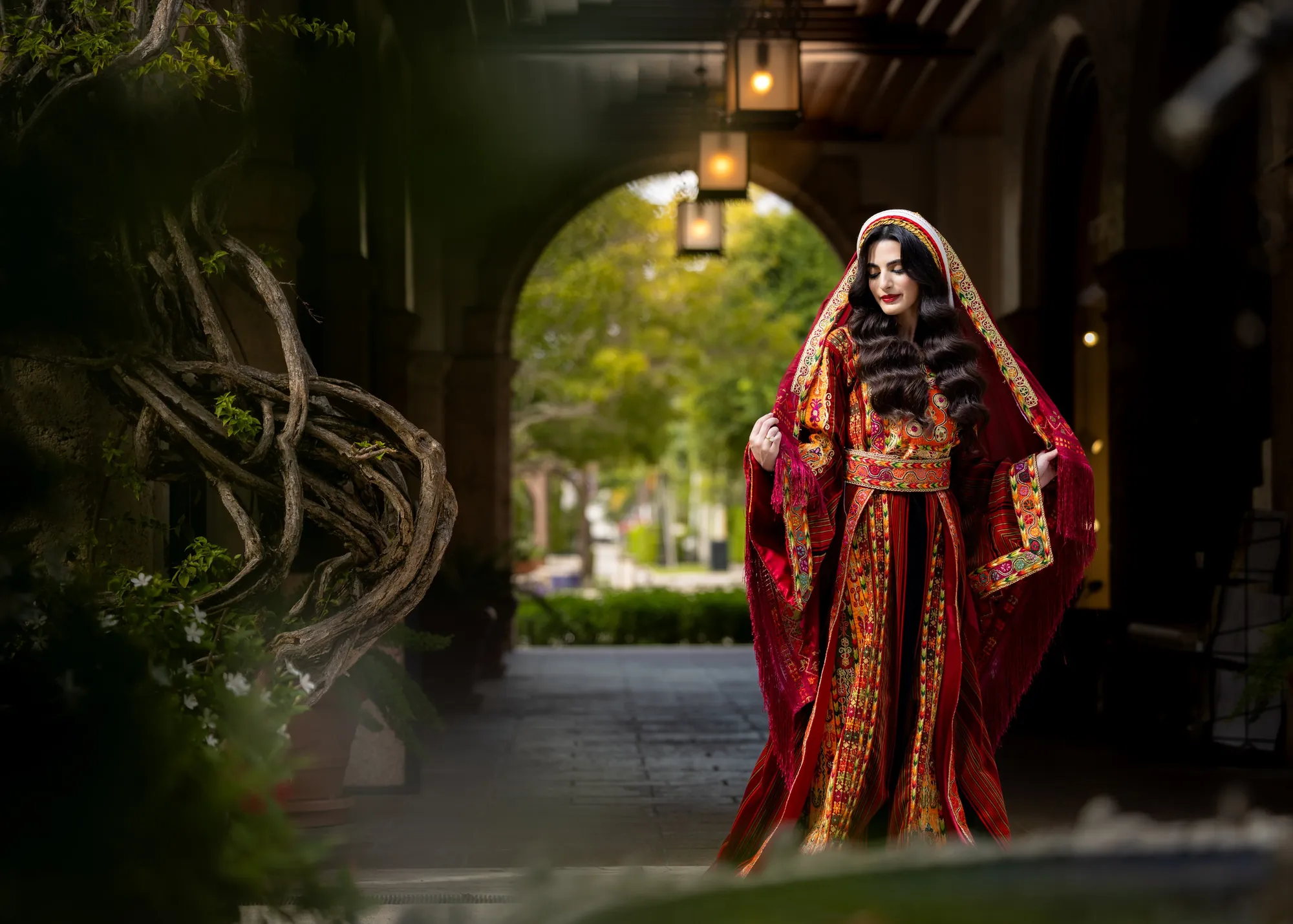
The henna night carries much of the colour of the weekend. The bride is often in an embroidered thobe, there is henna, singing, and a room full of women who have known each other a long time. It is also the event most often under-covered, because it falls outside a standard wedding-day package. If your weekend includes one, we plan it into the same coverage rather than treating it as an extra.
More of this work is on the henna gallery.
The zaffa and the entrance
The zaffa does not wait for anyone. Drums start, the room turns toward the door, and the couple comes through a corridor of people that closes behind them as they move. There is no second take, the light is whatever the venue gives you, and the best frames are usually the ones you were already standing in the right place for. This is the part of the night where knowing what happens next is worth more than any piece of equipment.
Dabke, and the rest of the night
Once the dabke line forms it reshapes the whole floor — it grows, it doubles back, and the people you most want in the frame keep changing position. We shoot it as it happens rather than staging it afterwards, and we stay for the end of the night, because the sahra is usually where the least guarded pictures of the family come from.
Films of these moments are on the films page, and the full photographic range is on the weddings gallery.
The thobe deserves its own frames
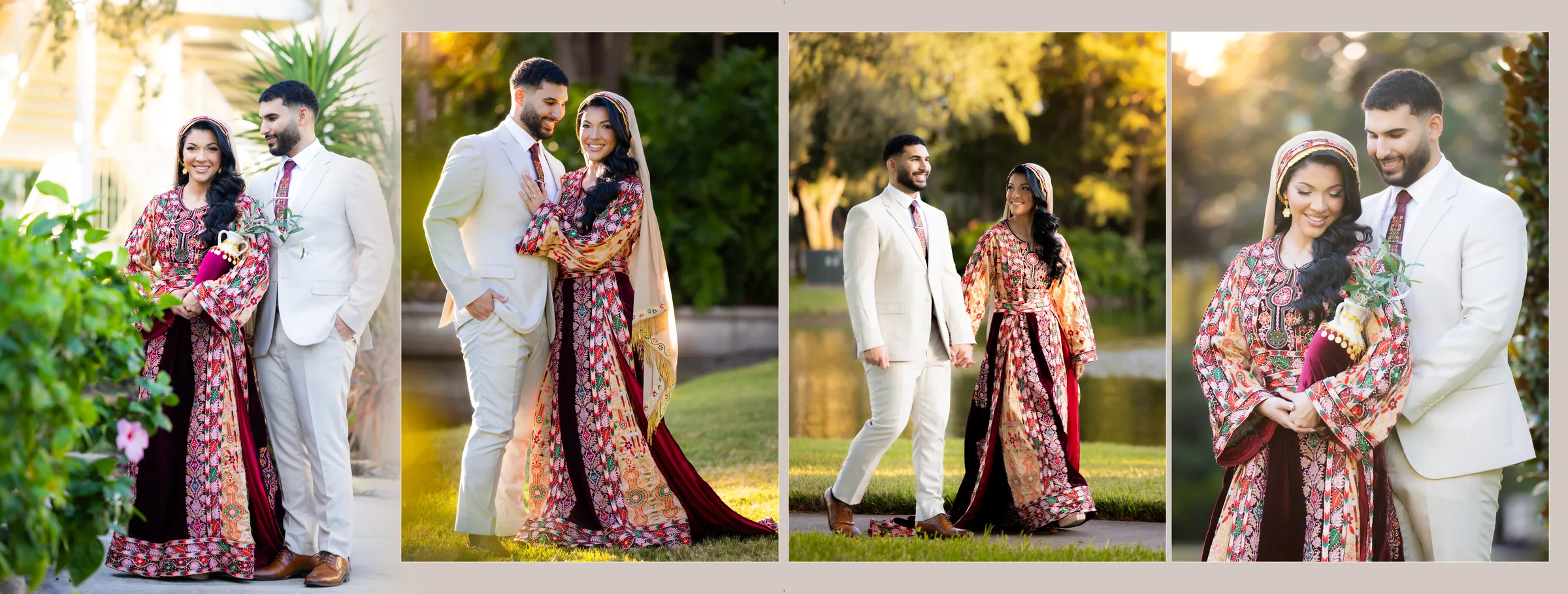
A hand-embroidered thobe can represent months of work, and the detail in it disappears entirely in a wide reception shot. We photograph the embroidery the way a dress is photographed — close, in good light, before the evening starts — so the panels, sleeves and stitching are actually legible in the gallery and in the album.
Photography and film, one team
Photography and film are coordinated on the same date rather than booked as two crews who meet for the first time at the venue. That matters most during the zaffa and the entrance, when both are working the same narrow corridor at the same moment. Options are discussed on the consultation.
Where we work
We are based in South Florida and cover weddings across Florida, and we travel — Texas, California, Georgia, North Carolina, New Orleans and elsewhere in the United States, as well as destination celebrations. If your family is spread across more than one city, that is a normal conversation for us rather than a complication.
Not only Palestinian families
Palestinian weddings are the largest part of our work, and they are not the whole of it. We photograph Lebanese, Syrian, Egyptian, Iraqi and Jordanian weddings, and Arab and Middle Eastern celebrations of every background. If you are not sure whether we are the right fit, ask us — it is a short conversation.